Why You Shouldn't Fear AI Replacing You, Even Though It Might
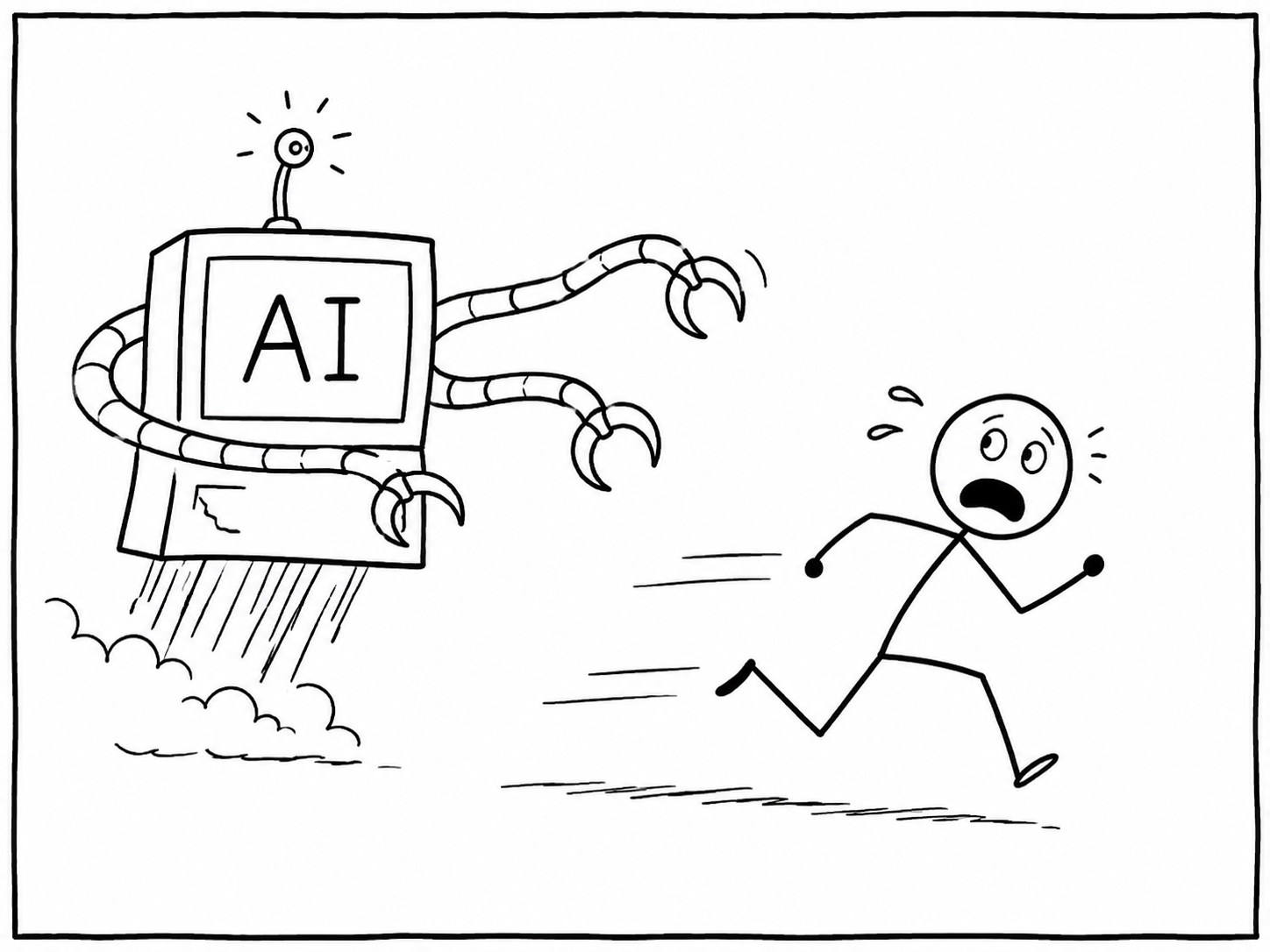
Recently, I was talking to an architect and business owner about the current state of the market, and how AI could reshape the economy.
They told me that they were genuinely scared. Not just concerned about their business or career, but scared about what they were supposed to do with their lives if AI really does become capable of replacing all of us.
How can I prepare for that? What should I tell my loved ones to do?
I thought about it for a moment. Because, honestly, I understand the fear. I'm a Software Engineer, and if there's one thing I've learned from the last few years, it's that AI is moving much faster than I personally expected.
Eventually, I gave them an answer that seemed to calm them down completely:
You probably shouldn't do anything about it. Stay adaptable, but continue living your life.
And no, this is not some sort of indifference message. There's a rationale behind this answer. We could frame it almost mathematically:
Decision A: Let fear of AI dominate your life and constantly optimize your life/education around it.
Decision B: Build a career and life you actually value while remaining adaptable to technological change.
If AI doesn't replace all of us, B probably leaves you better.
If AI does replace all of us, B doesn't leave you meaningfully worse off than A, because you weren't going to personally solve mass technological unemployment by choosing the perfect career anyway.
And even if AI does replace all of us, it probably won't happen overnight. You'll have time to adapt as reality unfolds.
My advice is to remain calm, even if half of the world is screaming. We can't rule out the possibility of AGI¹. But we've been predicting human-level AI for decades, and history has repeatedly shown how difficult it is to predict when it will actually arrive.
As Amara's law states:
We tend to overestimate the effect of a technology in the short run and underestimate the effect in the long run.
Maybe AI will prove that law right. Maybe it won't.
But that's precisely the point.
We don't know.
And if we don't know whether AGI is five years away, twenty years away, or something we will never achieve, I don't think the rational response is to put your life on hold trying to prepare for every possible future.
Learn. Adapt. Pay attention. Build things. Build relationships. Build a life you actually want to live.
Don't let the possibility of a radically different future prevent you from living in the one you actually have.
¹ In this article, I use “AGI” (artificial general intelligence) to mean an AI system capable of performing a broad range of intellectual tasks at a level comparable to or exceeding humans.
If you enjoyed this article, consider subscribing to my newsletter. I write every week about entrepreneurship, technology and AI. You can also follow me on X, where I share ideas and insights daily.